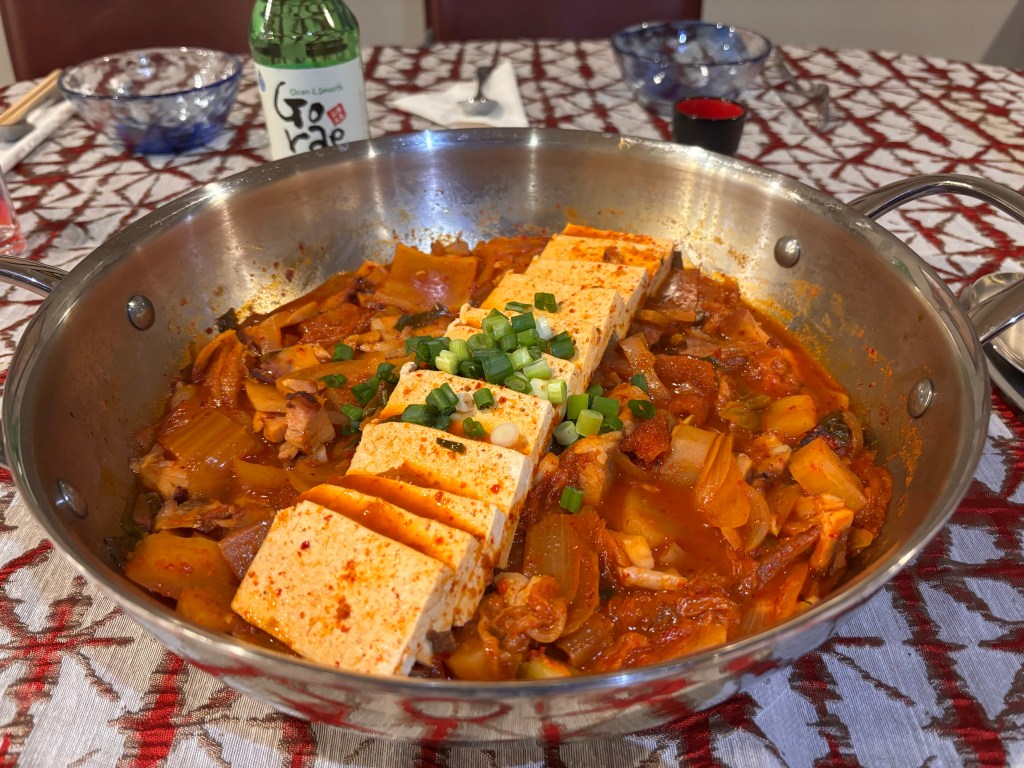
We recently had a delicious kimchi jjigae at one of our favorite Korean restaurants, Maru. We decided to try this recipe by Maangchi: https://www.maangchi.com/recipe/kimchi-jjigae. The video in the recipe was particularly helpful to demonstrate technique, such when to let the stew vigorously boil at medium-high heat.
Our modifications: first, we made the anchovy, daikon, kombu, and scallion head stock per the instructions. We still had some daikon leftover, so we added it to the stew later.
Second, for the kimchi we used 3/4 lb aged cabbage kimchi (Bibigo brand) and 1/4 lb radish kimchi (Jongga brand), each cut into bite-sized pieces. We added 1/4 cup kimchi liquid.
Third, in addition to the sliced onion, we added 1/2 lb fully cooked crispy skin pork (leftovers from a local Cantonese restaurant)—cut into bite-sized pieces—and the remaining daikon (about 1 cup, peeled and thinly sliced along the vertical). We added 2 cups of strained anchovy broth, and we set aside the remaining 1/2 cup for future use (see Note below).
Fourth, we omitted the 1 tsp salt. Instead, after cooking the stew for 10 mins, we added 1 tsp fish sauce to the kimchi stew, stirring it in before we placed the sliced tofu overtop and then cooked for an additional 15 mins. Other than that, we followed the recipe.
This was delicious, and we enjoyed it a lot. It was the closest to restaurant-level kimchi jjigae we have made at home. (Nov. 2026)
Note: We have about half the stew left, but only 3 out of 12 slices of tofu. This is because the mild-tasting tofu offset the spiciness of the jjigae (akin to Indian raita balancing out a spicy biryani). When we reheat the jjigae, we may add 2 Tbsp to 1/4 cup (4 Tbsp) of the anchovy broth to the stew, then add supplement with more slices of new (uncooked) tofu and reheat, covered on medium heat, for 10-15 mins.

