-
I cook as a hobby, and I maintain this blog primarily to keep track of recipes that my family has enjoyed over the years. I started blogging back in 2015, in response to requests from friends for recipes they had seen me post on Facebook (but that I couldn’t easily catalog). My original blog was on another platform that became less user-friendly over time. I migrated my blog to WordPress earlier this year, and I’ve spent more time than expected reformatting the migrated posts.
This blog is and always will be a work in progress. For example, I currently provide Tags for posts, but I have not coded for Categories. I also generally try to share the recipes themselves in my posts, but in cases where the recipe is not available online, I try to identify the source (e.g., the cookbook title and author) as needed. In some cases, such as where a family has shared their recipe with me but hasn’t authorized me to share it widely, I post a photo of the dish with that proviso.
I recently added a Search widget to this blog. On the desktop version, the Search bar appears prominently on the left hand side. But for some reason, it is hidden on the mobile app. If you’re on your phone, tap on the SHOW tab at the top left of the home page. That will reveal another screen with the Search bar.
I hope you enjoy exploring my blog and find some recipes to try.
-
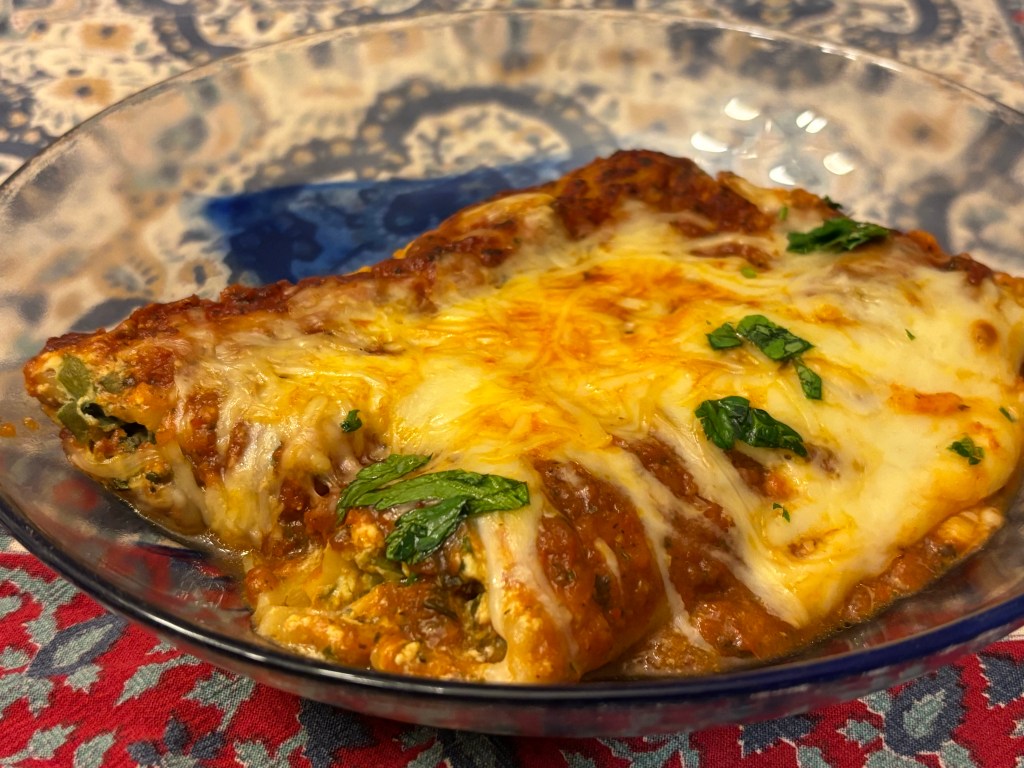
My husband had a craving for stuffed shells, and we settled on spinach and ricotta manicotti. We tried this recipe: https://www.recipetineats.com/spinach-ricotta-cannelloni/.
Our modifications: first, we used 1 lb uncooked manicotti shells, which were the right amount for the spinach ricotta filling. The stuffed shells also fit in a 13 x 9” baking dish.
Second, instead of passata, we used 28 oz of no-salt crushed tomatoes.
Third, because manicotti is larger than cannelloni, the pasta took longer than 30 mins at 350 to bake. We increased the baking time to approx. 50-55 mins just to cook the pasta, and then added the cheese and baked for an additional 15 mins.
Fourth, instead of frozen spinach, we used 8 oz of fresh baby spinach, which we roughly chopped before folding into the ricotta filling. We also used freshly grated nutmeg (from a whole nutmeg).
Fifth, we found 1 1/2 bags (8 oz each) of Tillamook shredded mozzarella sufficient for both the filling and the topping. We used Del Gioisio shredded parmesan (about 4/5 of the 5 oz container).
This was a tasty dish. We enjoyed it. (Nov. 2025)
-

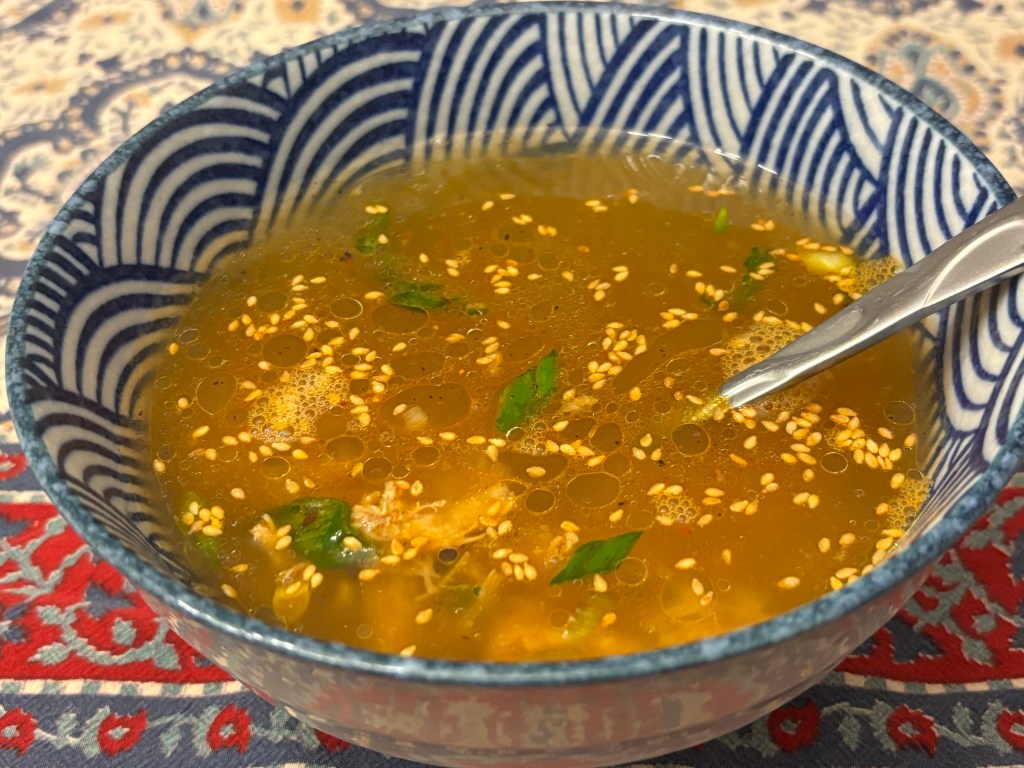
We made a buttermilk-marinated turkey breast for Thanksgiving (see Note 1 below), and we decided to make a post-Thanksgiving recipe inspired from my childhood: leftover turkey slow-cooked broth (gomtang). We also picked up a few tips from this post: https://kimchimari.com/spicy-turkey-leftover-soup-korean/.
First, remove as much cooked turkey meat from the turkey carcass (here, the breast bone and ribs) as possible. Hand-shred the meat into small bite-sized pieces and set aside in the fridge.
Second, place the turkey carcass (here, the roasted breast bone plus a frozen, raw turkey back with skin and attached meat) in a pressure cooker. Add 1 medium onion (peeled and halved), 6 garlic cloves (lightly smashed, trimmed, and peeled), 2 bay leaves, and 1 tsp kosher salt. Pour 14 cups water into the pot, (see Note 2 below). Seal the pressure cooker, heat until you reach full pressure (about 15 mins), and then reduce heat (to about medium heat) while still maintaining full pressure for 1 hour.
Third, once soup has finished cooking, remove from heat, release pressure, and remove the solids (turkey back, breast bone). Shred the meat and place in a bowl, taking care to remove any bones (esp. from the turkey neck). In addition, take the shredded, chilled turkey breast and reheat it by gently dunking in the hot broth (we use this sieved scoop: https://us.josephjoseph.com/products/scoop-plus-colander-black). The total shredded turkey meat probably will yield 2.5 lb.
Fourth, lightly season the soup to taste. We added about 1/2 tsp each salt and sugar and 1/8 tsp black pepper.
Fifth, season the shredded turkey meat with “yangnyum.” “Yangnyum” refers to a simple mixture of soy sauce, sesame oil, and some seasonings. For 2.5 lb shredded turkey, the yangnyum mixture will be about 2 to 2.5 Tbsp soy sauce, 2 to 2.5 Tbsp toasted sesame oil, 1 Tbsp Korean red pepper flakes, 1 tsp garlic powder, and 2 finely chopped scallions. This time we also added 2 tsp toasted sesame seeds. (The sauce is according to taste, so that’s why the measurements are approximate.) In the meantime, reheat the turkey broth until it’s steaming.
Finally, assemble the soup: ladle about 2.5 to 3 cups of the turkey broth into a medium soup bowl (we use a round Japanese ceramic bowl). Then add approx. 3/4 cup of the seasoned shredded turkey meat (see below). Serve with steamed rice (short grain or jasmine) and a side of radish kimchi. (Nov. 2025)
Note 1: This is the Thanksgiving turkey recipe we make most years: https://cookingadventures.blog/2020/11/26/buttermilk-brined-roast-turkey-breast-we-tried/. This year, we purchased a Shady Brook Farms bone-in turkey breast, which included a turkey back. When preparing the two breast halves for the buttermilk marinade, we carefully removed the turkey back (and backside meat) and froze it. That’s the frozen turkey back we used for today’s broth.
Note 2: Each pressure cooker / instant pot has a maximum fill line marked on the inside lining. We added 14 cups, but you can add a cup or two less as needed to stay below that max fill line.
-
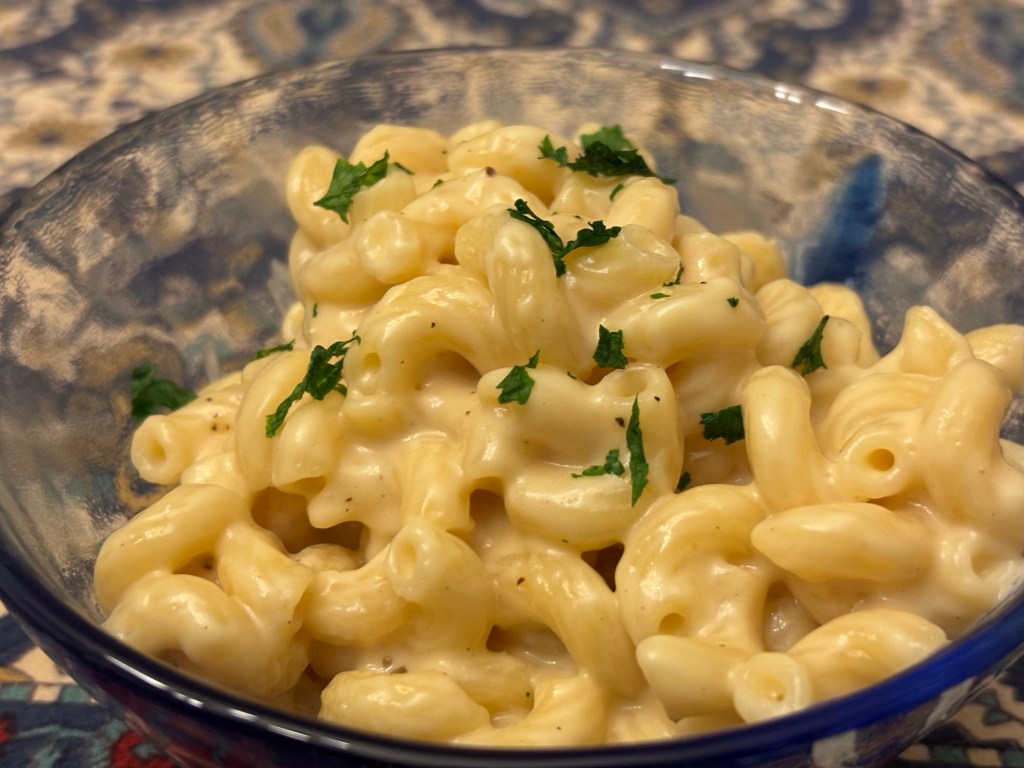
Mac and cheese is one of my husband’s favorite dishes. I always imagined it was too complicated to make at home, but we decided to try this recipe from J. Kenji Lopez-Alt: https://www.seriouseats.com/ingredient-stovetop-mac-and-cheese-recipe. It ingeniously calls for 6 oz each uncooked elbow macaroni, evaporated milk, and freshly shredded cheddar cheese.
Our modifications: first, we doubled the recipe to 12 oz uncooked pasta, 12 oz evaporated milk (which is the standard can size), and 12 oz shredded cheese. Second, to cook the pasta, we used our medium All-Clad pot. We found that 3 to 3.5 cups cold water just covered the 12 oz pasta. We cooked for 6 mins, but may reduce to 5 mins the next time to ensure the pasta doesn’t overcook (it was soft at 6 mins, when we had been aiming for not quite al dente). Third, for the cheese, we used a 7 oz block of Somerset extra mature cheddar, which we hand-shredded into wide shreds and 5 oz Tillamook shredded Mexican cheese (see Note below). Finally, at the end of cooking, we lightly seasoned to taste with salt, freshly ground black pepper, and 1/4 tsp dry mustard. This mac and cheese came together remarkably fast and tasted quite luxurious. (Nov. 2025)
Note: We highly recommend using a block of cheese instead of using store-bought shredded cheese. The latter had difficulty melting into the pasta mixture. Also, we found extra sharp cheddar too overpowering. So we may try this recipe again with mild or slightly sharp cheddar.
-
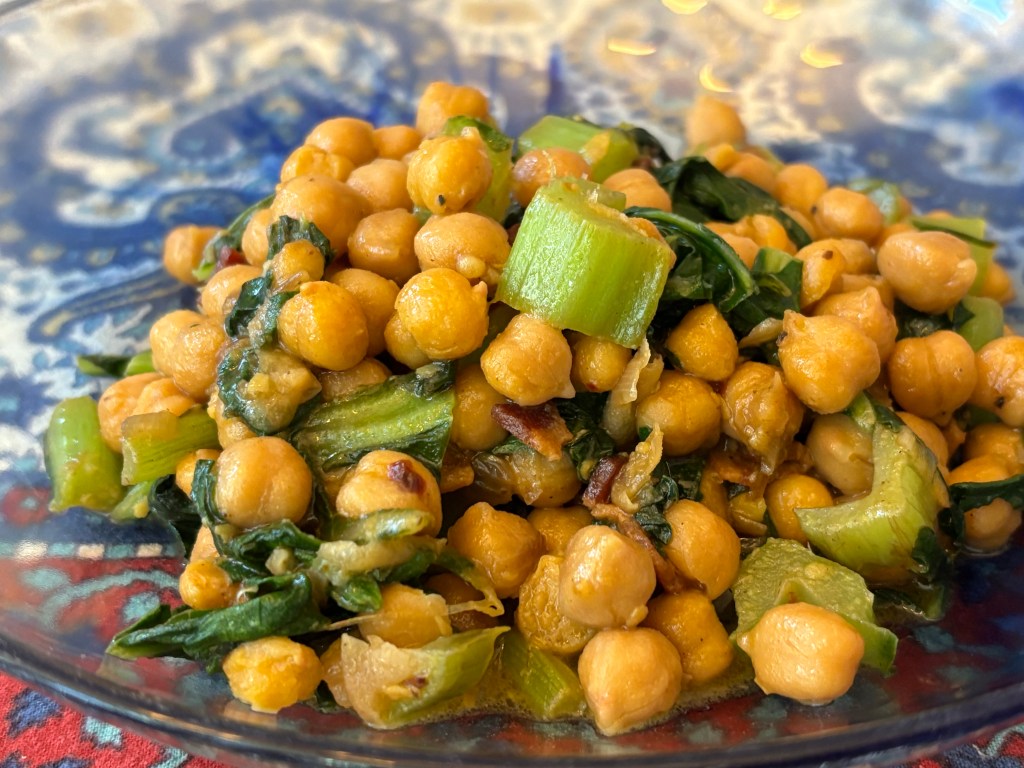
This is an easy recipe with surprisingly complex flavors: https://www.thekitchn.com/recipe-swiss-chard-with-garbanzo-beans-249801. The crunch of the Swiss chard steps reminded us of celery without the sharp flavor.
Our modifications: first, based on our pantry, we used bacon instead of pancetta. Specifically, we cut frozen, center-cut bacon into matchsticks (3 cross sectional slabs). Second, towards the end of cooking, we seasoned lightly with kosher salt, black pepper, and sugar. Third, once we removed from heat, we folded in freshly squeezed lime juice.
This was delicious and satisfying recipe. We made it twice today (although we swapped out beet greens for Swiss chard). We definitely can make again. (Nov. 2025)
-
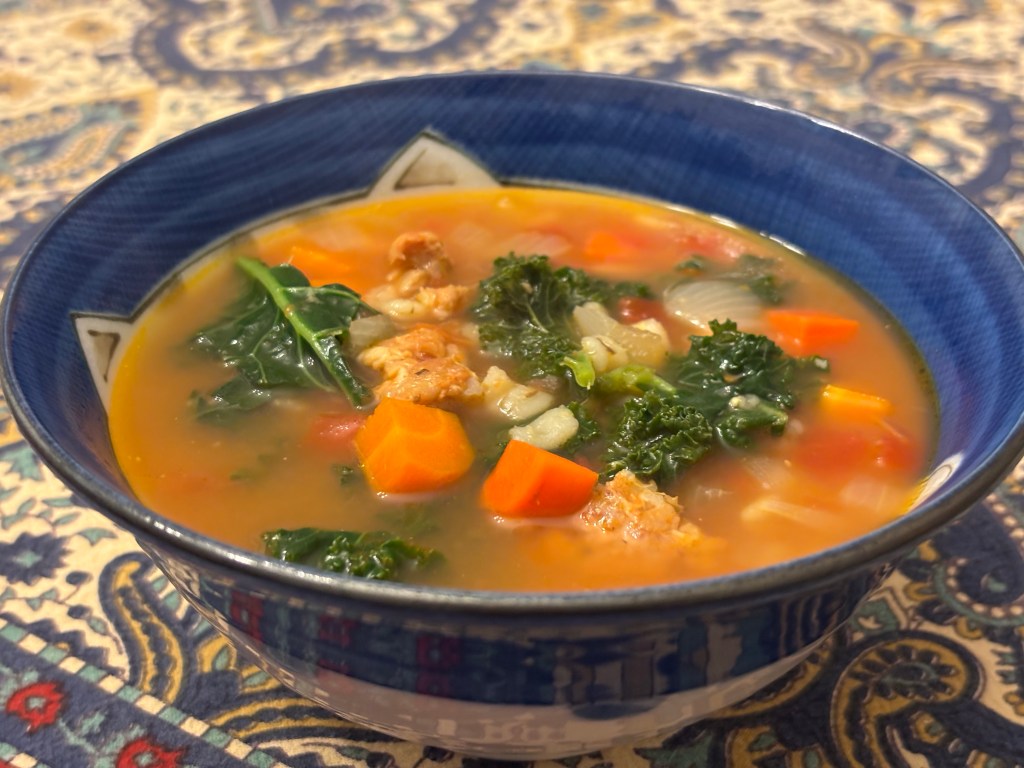
This is an easy recipe that makes a nice, hearty soup: https://cooking.nytimes.com/recipes/1026506-sausage-and-barley-soup-with-greens?smid=ck-recipe-iOS-share.
Our modifications: first, we used two links of raw spicy Italian chicken sausage from Whole Foods. Second, for the greens, we found that half a bunch of curly kale was about 6 dry cups. Third, we added a parmesan rind along with the broth and canned tomatoes, and we added 2 Tbsp shredded parmesan. At the end of cooking, we added 2 Tbsp red wine vinegar. Fourth, we recommend adding 1 additional cup chicken broth (for a total of 7 cups) to keep the soup brothy.
This was a flavorful, delicious recipe. Definitely a keeper. (Nov. 2025)
-
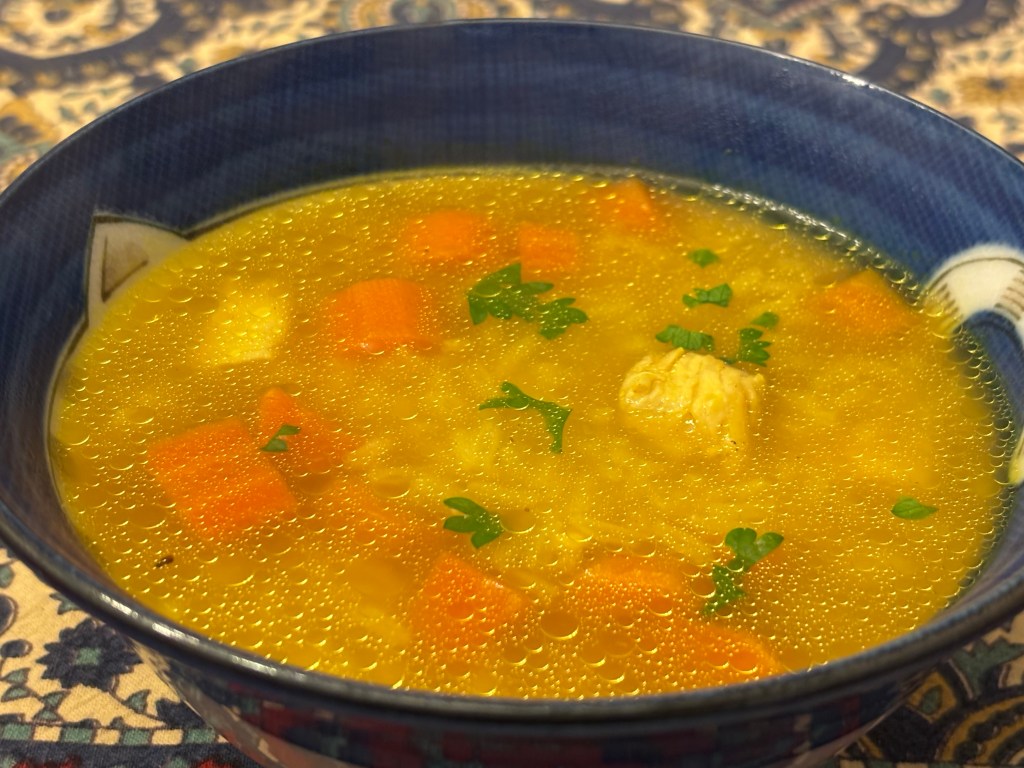
After having the most delicious chicken rice soup at Nick’s Sandwich Shop (Saddle Brook, NJ), we searched online for a recipe that had similar characteristics. Nick’s scratch version featured a clear broth with a golden yellow hue, dotted with diced carrots and lightly poached, diced chicken breast. The soup was flavorful yet uncluttered, and the long grain rice was perfectly cooked.
First, we loosely followed this recipe for homemade chicken broth: https://iowagirleats.com/easy-instant-pot-chicken-stock/. For the chicken, we used frozen chicken back, chicken skin and fat (from a few thighs and drumsticks); and 3/4 lb fresh chicken wings. For the aromatics, we used 1 medium skin-on onion (halved along the grain), 1 skin-on head of garlic (halved crosswise), 2 large carrots (each cut into two long pieces), 3 celery stalks (each cut in two long pieces), the white and pale green part of 1 leek (rinsed throughly and then cut in half crosswise), trimmed mushroom stems (from 4 cremini mushrooms), 1/4 bunch of fresh parsley, 2 sprigs thyme, and 1 tsp each salt and black peppercorns. We also added 2 bay leaves (not in recipe). Due to time constraints, we pressure cooked on high for 30 mins (after a 30-min ramp up, for a total of 1 hour pressure cooking), and we did a quick release. After cooking, we strained the broth, saving only the cooked carrots and the chicken wings. This recipe yielded a little over 10 cups strained chicken broth (see Note 1 below).
Second, loosely following this recipe for soup to rice ratio: https://iowagirleats.com/easy-chicken-and-rice-soup/, we measured out 9 cups of broth and placed it in a large Dutch oven (we have a nonstick black All-Clad). To mimic the golden hue of Nick’s broth, we added 1/2 tsp ground turmeric. Upon tasting the broth, we found it surprisingly bland and lacking chicken flavor (see Note 2 below). We added 1 Tbsp Better Than Bouillon chicken concentrate. We also seasoned to taste with salt, ground black pepper, and a dash of sugar.
Third, we saved the cooked chicken wings for future use. We carefully diced the cooked carrots and set them aside. Using a separate cutting board, we diced 1 boneless fresh chicken breast and then lightly seasoned with salt and black pepper.
Finally, we brought the chicken broth to a boil, then added 1 cup uncooked jasmine rice and the diced chicken breast. We cooked the soup on medium heat, uncovered, for 15 mins. We then folded in the cooked, diced carrots and let cook on medium for 1 additional min (to warm up the carrots). We served in bowls and garnished with freshly torn parsley. (Nov. 2025)
Note 1: We purposely saved 1 cup of the original chicken broth. If the chicken and rice soup has leftovers, the rice likely will absorb broth overnight like a sponge – and you could supplement the soup with some of the extra broth.
Note 2: The lack of developed flavor in the broth is not a reflection of Iowa Girl Eats’ recipe. We took inspiration from the ingredients in her broth, but we couldn’t pressure cook in two 1-hour rounds (2 hours total).
-
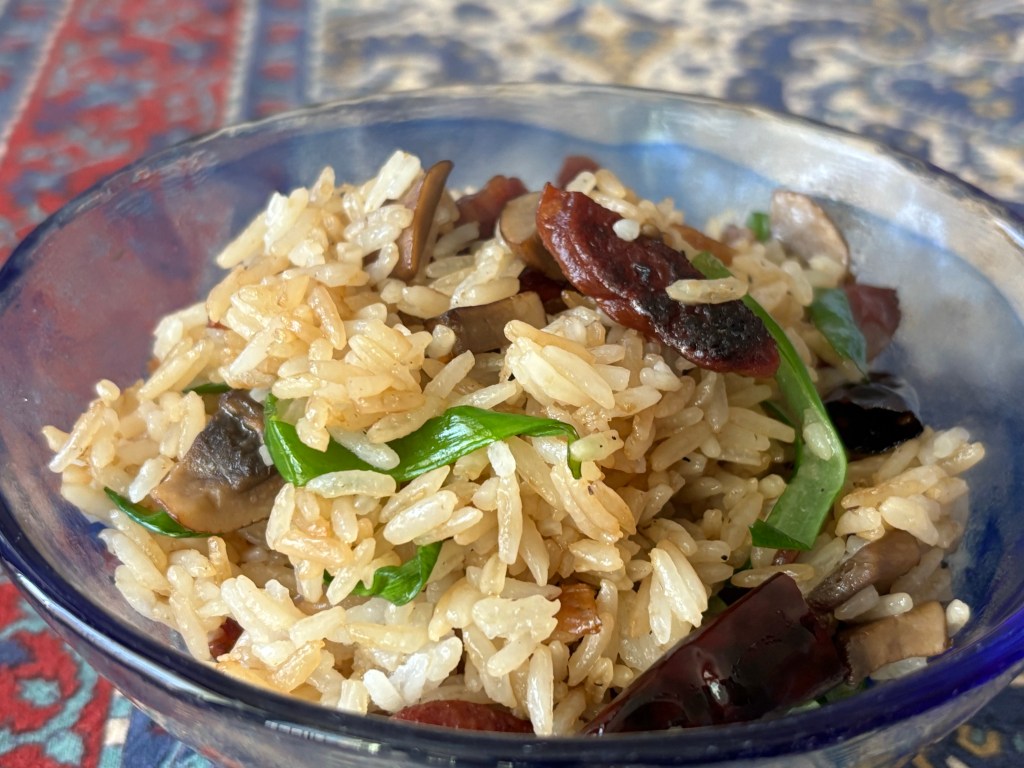
I love Chinese sticky rice, and I have had a craving for it ever since I stumbled upon this NYT recipe: https://cooking.nytimes.com/recipes/1014807-savory-sticky-rice-bowls-or-stir-fried-sticky-rice?smid=ck-recipe-iOS-share. Unfortunately, we don’t have sweet rice in our pantry, so we tried this recipe using jasmine rice.
In addition to not using sweet rice, we made a few other modifications: first, we halved the recipe, using 2 cups cooked jasmine rice. Second, we omitted the bacon and onion. For the Chinese sausage (lap cheong), we used a version made of pork and chicken. We included four Cremini mushrooms (in lieu of shiitake), diced.
Third, instead of Chinese sweet wine, we used Shao Hsing wine and supplemented with 1/4 tsp sugar.
Finally, to mimic the texture of sticky rice, we drizzled 1/2 tsp toasted sesame oil along the perimeter of the rice mixture (after adding the scallion slivers) and seared on medium for a few mins, to create a crunchy, chewy surface where possible.
This was a good recipe, and we hope to make it again once we have sweet long-grain rice on hand. (Nov. 2025)
-
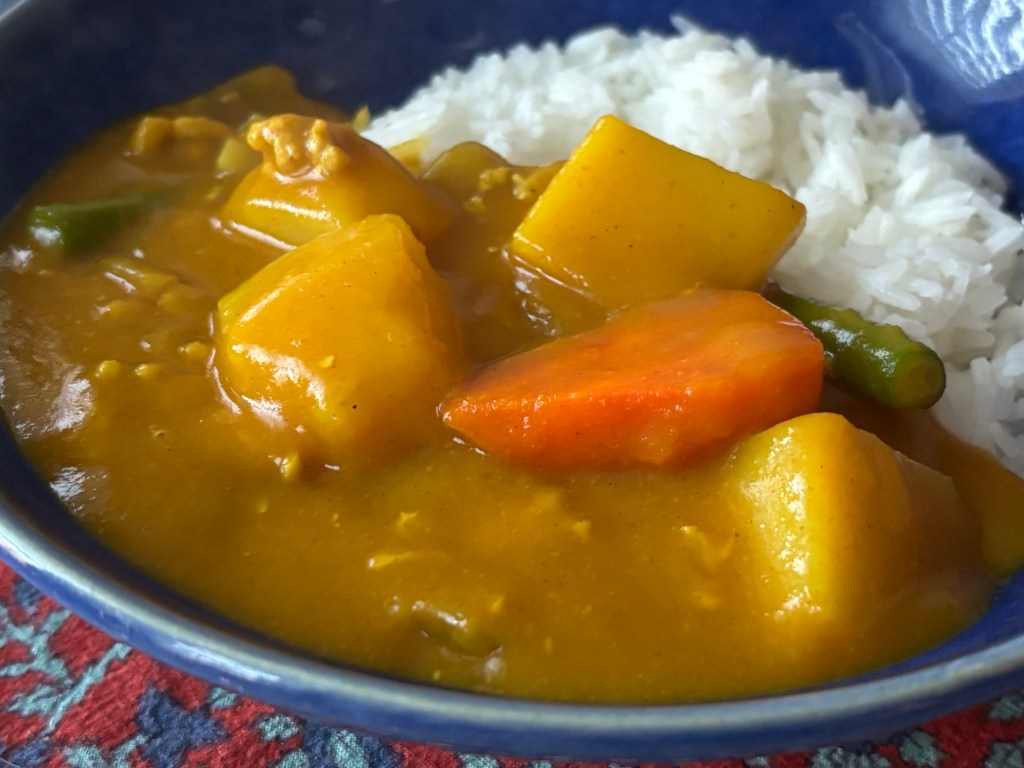
We make Japanese or Korean curry rice quite often, but this time decided to try some new techniques, including cutting the vegetables into large chunks. The results turned out well, so I wanted to document this while fresh in my mind.
Our ingredients: 1 to 1.5 tsp unsalted butter; 1 medium onion, cut into 1” dice (for each onion half, we made 2 cuts along the axis and 1 cross-wise cut); 2 tsp canola oil; 1/2 lb minced chicken; 1400 ml liquid (250 ml no-salt chicken broth + 1150 ml water); 1 small-medium carrot, cut Japanese gem-style (see Note below); 1 large Russet potato, cut into 1.5” x 1” chunks; 6 oz green beans, cut into 1.5” long straws; and two 100 g packets spicy Ottogi Curry sauce mix (a Korean curry mix in powder form that calls for 700 ml liquid per packet – see Note 2).
First, using a medium-size Dutch oven, heat butter on medium heat, then add the onion. Saute until the onion is browned and caramelized. Add canola oil, and then add minced chicken. Saute on medium-high heat until chicken is browned.
Second, pour in 1400 ml water (or in our case, a mix of no-salt chicken broth and water). Then add the potato and carrot. Uncovered, bring to a boil and then reduce to a simmer for about 10 mins. Then fold in the string beans.
Third, turn off heat but leave on the burner. Stir in the Ottogi curry powder, taking care to smooth out the lumps. Cover and let sit (with the heat still off) to let the flavors meld. (Nov. 2025)
Note: We took inspiration from this blogpost: https://www.justonecookbook.com/simple-chicken-curry/. It includes an explanation of gem-like cuts for carrots to maximize surface area.
Note 2: This is the specific Ottogi curry mix we like: https://www.otoki.com/en/product/product_detail?categorySeqFirst=2&productIdx=2657.
Note 3: We made a vegetarian version with roasted cauliflower (1/4 head, cut into florets tossed in oil and roasted at 425), 1 small daikon radish (peeled and cut into 1” thick penny slices, each halved), 2 small carrots cut into gem-like pieces, 3/4 cup cashews (parboiled for 10 mins and drained), 1/2 cup each frozen corn and sweet peas, and 1/2 cup frozen chopped spinach. (Apr. 2026)
-
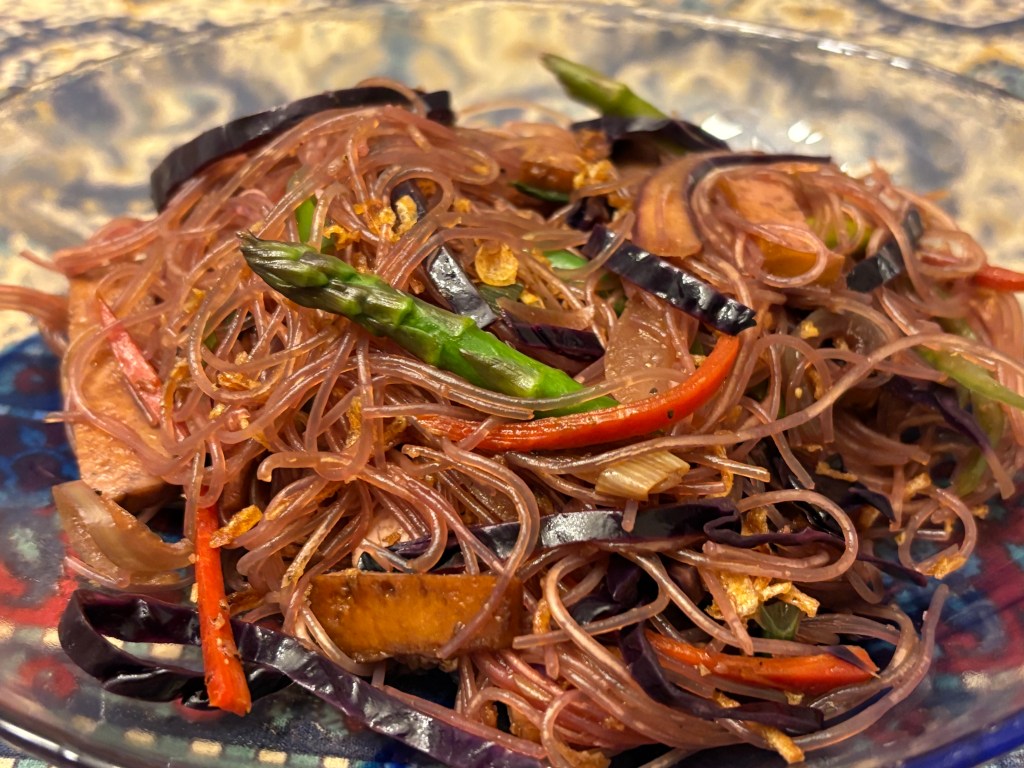
I first had pancit during college, when a Filipina-American friend made a huge batch for a potluck. Today we had a craving for a plant-forward version, so we decided to try this recipe: https://www.lifesambrosia.com/grandmas-pancit-recipe/
Unfortunately, we found the seasoning (1 Tbsp soy sauce, salt and pepper) too one-note, so we also took some seasoning tips from this recipe: https://www.billyparisi.com/pancit/.
Our modifications: first, instead of 1 lb pork, we used an 11 oz package of KK brand smoked tofu (see Note below), cut into 1/2” thick slices and then into strips (3 vertical strips per slice). Using a large wok, we sauteed the tofu strips in a 1 Tbsp canola oil on high heat until seared. We reduced heat to med-high, then added 1 medium onion (sliced vertically rather than chopped), 6 minced garlic cloves, and 1 Tbsp soy sauce.
Second, for the vegetables, we used: 1.5 cups julienned red cabbage (about 1/2 a small head); 1 small carrot, peeled and julienned; 1 cup green beans, julienned; and 6 stalks asparagus, sliced 2” thick on a diagonal. We sauteed them on med-high heat until crisp-tender (about 3 mins). Then we added 1 cup no-salt chicken broth, bringing to a boil before reducing to low heat.
Third, separately we soaked 6 bundles bean thread noodles (Long Kou vermicelli) in hot water for 1 min, then quickly rinsed in cold water and drained. We then added the drained noodles to the wok, and we gently incorporated the noodles into the veggies and broth.
Finally, we found the seasoning lackluster, so we added 1 Tbsp fish sauce, 1 Tbsp oyster sauce, 1 Tbsp dark soy sauce, 1/8 tsp garlic powder, juice from 1/3 lemon, and 1/4 cup fried shallots for depths of flavor, acid, and texture. (Nov. 2025)
Note: For more info on smoked tofu, this article provides a good overview: https://www.seriouseats.com/shopping-cooking-guide-different-tofu-types (scroll down halfway). The brand of smoked tofu that we used for this recipe has a red and white label.
-
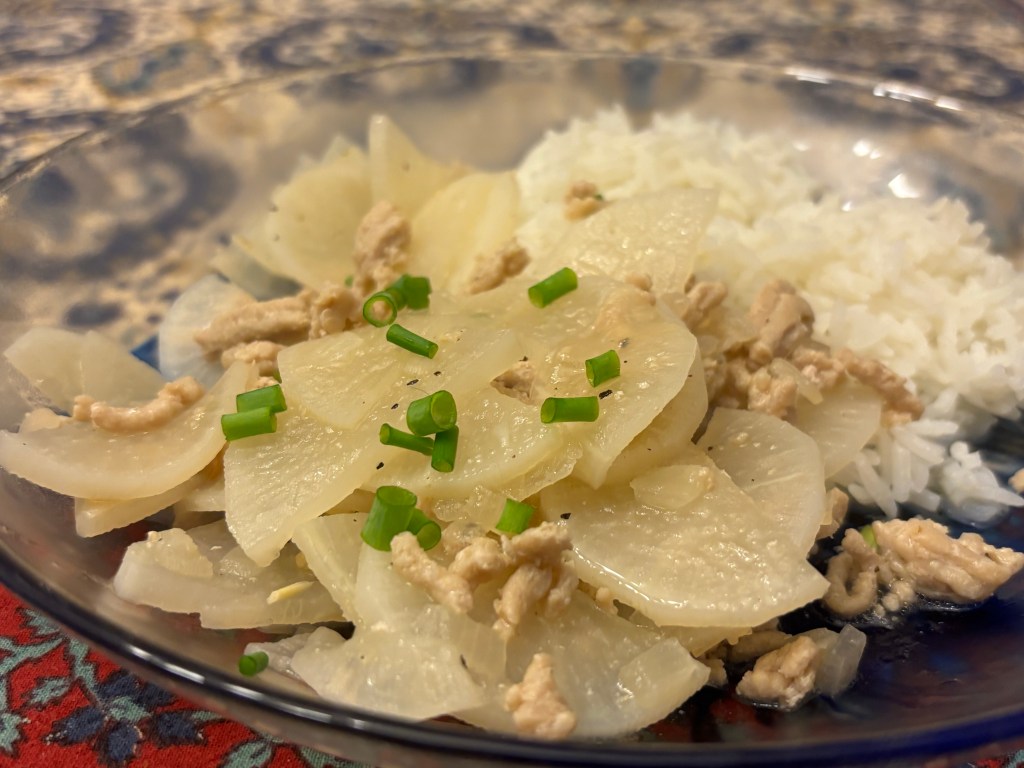
We decided to try this recipe: https://salu-salo.com/sauteed-daikon-ginisang-labanos/
Our only modifications: instead of 1/2 lb minced pork, we used 1/2 lb minced chicken. This was easy and delicious, and we’ll definitely make it again. (Oct. 2025)
-
Subscribe
Subscribed
Have a WordPress.com account? Log in now.

